
India's Democracy at Risk
INDIA'S DEMOCRACY AT RISK: THE RISE OF CRIMINAL POLITICIANS
INTRODUCTION
India, the world's largest democracy, faces a persistent and escalating challenge: the criminalisation of its politics. This phenomenon, marked by the increasing entry of individuals with serious criminal backgrounds into legislative bodies, continues to cast a long shadow over the nation's democratic institutions. Recent analyses from 2024 and 2025 reveal an alarming trend, indicating that a significant percentage of elected representatives at both parliamentary and state assembly levels carry declared criminal cases, many involving heinous offenses. This infiltration by "lawbreakers" into the ranks of "lawmakers" undermines the very foundation of electoral integrity, public trust, and good governance.
The Association for Democratic Reforms (ADR), a prominent election watchdog, has consistently highlighted this critical issue through its comprehensive reports. Their 2024 and 2025 data provide stark insights into the pervasive nature of this problem, detailing the proportion of Members of Parliament (MPs) and Members of Legislative Assemblies (MLAs) with criminal antecedents across various states and political parties. Despite numerous judicial pronouncements and legislative efforts aimed at curbing this menace, the trend appears to be strengthening, driven by a complex interplay of factors including the "winnability" factor, opaque election funding, and slow judicial processes. This article delves into the current state of criminalisation in Indian politics, drawing upon the latest data, examining the implications for democracy, and exploring the ongoing interventions by the Supreme Court and other bodies to safeguard the integrity of India's political landscape.
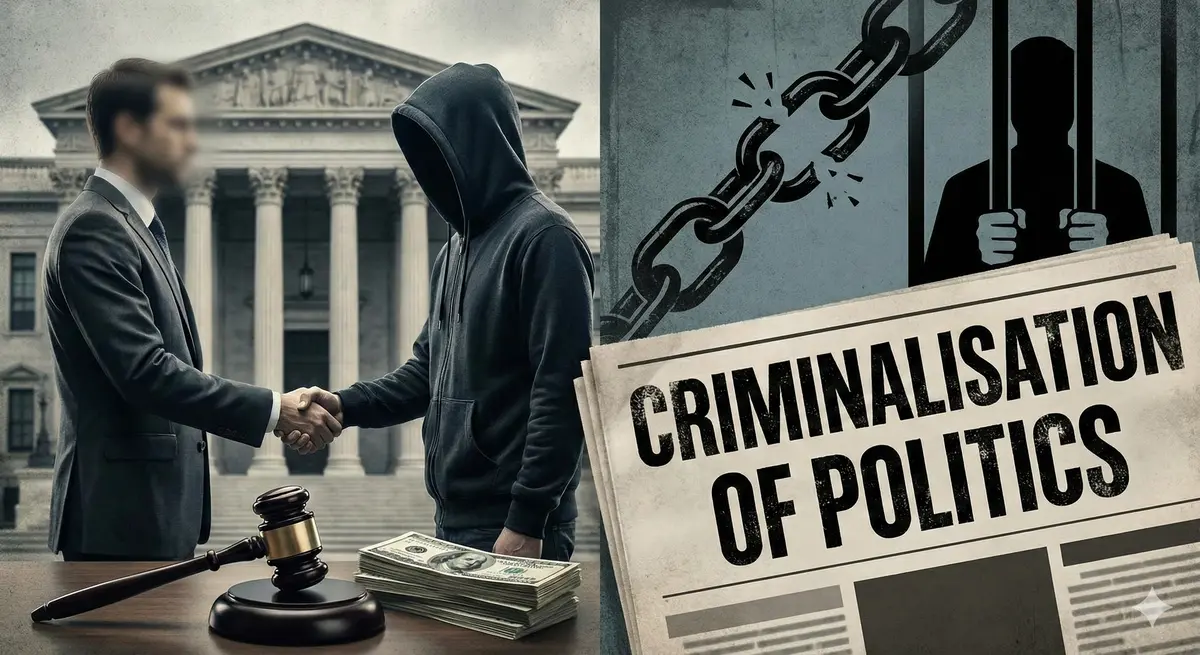
THE ALARMING RISE OF CRIMINAL RECORDS IN INDIAN POLITICS
The period spanning 2024 and 2025 has underscored the deepening entrenchment of individuals with criminal backgrounds in India's political system. Data released by the Association for Democratic Reforms (ADR) and other analyses paint a concerning picture of electoral integrity across the nation.
Lok Sabha 2024 Elections: A Snapshot of Criminal Antecedents
The 2024 Lok Sabha elections witnessed a record number of elected Members of Parliament (MPs) with declared criminal cases. According to an analysis by the ADR, 251 out of 543 newly elected Lok Sabha members, representing 46% of the Lower House, have criminal cases registered against them. This marks the highest number of candidates facing criminal charges to be elected to the Lok Sabha, showing a substantial increase from 23% in 2004, 30% in 2009, 34% in 2014, and 43% in 2019. A significant portion of these cases involves serious offenses. The ADR report indicates that 31% of the newly elected MPs face serious criminal cases, encompassing charges such as rape, murder (Section 302 IPC), attempt to murder (Section 307 IPC), kidnapping, and crimes against women. Specifically, four winning candidates declared cases related to murder, and 27 declared cases related to attempt to murder. Furthermore, 15 winning candidates declared cases related to crimes against women, including two facing rape charges under IPC Section 376. Forty-three candidates also declared cases related to hate speech.
The party-wise analysis for the 2024 Lok Sabha elections revealed that criminality cuts across the political spectrum. Of the 240 BJP MPs, 39% declared criminal cases, with 26% facing serious criminal charges. The Indian National Congress saw 49% of its 99 winning candidates declare criminal cases, with 32% facing serious charges. Among other major parties, 57% of Samajwadi Party's 37 winners, more than half of DMK's 22 MPs, and all four RJD MPs declared serious criminal cases.
State Assemblies 2024-2025: Widespread Criminalisation
The trend of criminalisation is equally pronounced, if not more, at the state assembly level. An ADR analysis from March 2025, covering 4,092 MLAs from 28 states and 3 Union Territories, found that 45% (1,861 MLAs) have declared criminal cases against them. Of these, 29% (1,205 MLAs) face serious criminal charges, including murder, attempted murder, kidnapping, and crimes against women. States like Andhra Pradesh (56%), Telangana (50%), and Bihar (49%) lead in the number of MLAs with serious criminal backgrounds. Uttar Pradesh recorded the highest absolute number with 154 MLAs (38% of its total) facing serious cases.
A separate report by ADR in October 2025 indicated that about 47% of ministers in India, across Union and State Cabinets, have declared criminal cases against themselves, with 27% facing serious charges. This figure encompasses murder, attempt to murder, kidnapping, and crimes against women. At the Union level, approximately 40% (29 of 72) of ministers in the Modi 3.0 ministry declared criminal cases. Notably, Dean Kuriakose (Congress, Kerala) had 88 criminal cases, 23 of which were serious IPC cases.
Serious Charges: A Deeper Concern
The increasing prevalence of "serious criminal cases" among elected representatives is particularly troubling. These are generally defined as offenses punishable by five years or more imprisonment, or non-bailable offenses. The fact that candidates with declared criminal cases have a significantly higher chance of winning elections further exacerbates the problem. In the 2024 Lok Sabha elections, the winning chances for candidates with declared criminal cases stood at 15.3%, compared to just 4.4% for candidates with clean backgrounds. This stark disparity highlights how the perceived "winnability" of such candidates often overshadows their integrity, perpetuating the cycle of criminalization.
ROOT CAUSES: WHY CRIMINALITY PERSISTS IN INDIAN POLITICS
The persistence of criminal elements in Indian politics is not a singular issue but a multifaceted problem stemming from deeply ingrained societal and structural factors.
The "Winnability" Factor and Politico-Criminal Nexus
One of the primary drivers is the "winnability" factor. Political parties often prioritize a candidate's perceived ability to win elections over their moral or legal standing. Candidates with criminal backgrounds frequently possess significant financial resources, local influence, and "muscle power" that enable them to dominate electoral contests and sway voters, sometimes through intimidation or inducements. This creates a vicious cycle where criminals enter politics for immunity and legitimacy, while politicians and parties use them for their coercive and financial power, fostering a deep-seated politico-criminal nexus. The Vohra Committee Report (1993) famously highlighted this nexus between politicians, criminals, and bureaucrats in the Indian administrative and political setup. In the 2024 Maharashtra and Jharkhand Assembly elections, political parties cited reasons like "strong administrative capacity" or "politically motivated" cases to justify selecting candidates with criminal records, often dismissing alternatives as lacking experience.
Money Power and Opaque Electoral Funding
The high cost of elections in India, coupled with opaque electoral financing, significantly contributes to the criminalisation of politics. Parties and candidates often rely on "black money" and funds from illegal activities to finance their campaigns. This reliance on undisclosed money deepens the nexus between crime and politics, as criminals become financiers and, subsequently, candidates, seeking to protect their interests once in power. The absence of comprehensive state funding for elections leaves a void that is often filled by illicit money, further compromising transparency and accountability.
Weak Law Enforcement and Slow Judicial Processes
The Indian criminal justice system is plagued by slow, inefficient processes and low conviction rates, which indirectly encourage criminal elements to enter politics. Trials against sitting MPs and MLAs often drag on for years, rendering criminal charges almost irrelevant to their political careers. Despite Supreme Court directives, such as the 2017 order to establish special courts for expeditious trials of legislators, progress has been slow, with over 5,000 such cases remaining pending as of 2024. This judicial delay, compounded by a lack of political will and frequent adjournments, allows politicians with criminal charges to continue holding office.
Lack of Internal Party Democracy and Voter Apathy
Many political parties in India suffer from weak internal democratic structures, allowing party leaders to handpick candidates based on electability rather than integrity. This often results in tickets being given to candidates with criminal backgrounds, circumventing internal scrutiny. Furthermore, voter apathy, particularly among the middle class, and a lack of detailed political awareness can lead to choices influenced by caste, religion, or superficial factors rather than a candidate's criminal record. Instances where parties failed to provide justifications for selecting candidates with criminal records, directly violating Supreme Court orders, highlight this systemic issue.
JUDICIAL INTERVENTIONS AND THEIR EFFICACY
The Indian judiciary, particularly the Supreme Court, has consistently expressed concern over the criminalisation of politics and has issued several landmark directives to address the issue. However, the efficacy of these interventions remains a subject of debate.
Key Supreme Court Judgments and Directives
Over two decades, the Supreme Court has issued pivotal judgments:
**Union of India v. Association for Democratic Reforms (2002)**: This ruling established the fundamental right of voters to know the antecedents of candidates, mandating the disclosure of educational qualifications, criminal records, and financial information via affidavits to the Election Commission of India (ECI).
**PUCL v. Union of India (2003)**: Reinforced the voter's right to information and struck down Section 33B of the Representation of People (Third Amendment) Act, which had nullified the 2002 ADR decision.
**Lily Thomas v. Union of India (2013)**: This landmark judgment scrapped the statutory escape clause in Section 8(4) of the Representation of the People Act, 1951, leading to the immediate disqualification of convicted legislators sentenced to two years or more imprisonment, even if an appeal was pending.
**Public Interest Foundation v. Union of India (2018 & 2019)**: The Court directed political parties to publish details of criminal cases against their candidates on their websites, in local and national newspapers, and on social media platforms. This information was to be published within 48 hours of candidate selection or not less than two weeks before the first date for filing nominations, whichever was earlier. Parties were also mandated to provide "detailed, merit-based justifications" for selecting candidates with criminal backgrounds, explaining why a candidate without a criminal record could not have been chosen. The ECI was directed to create a dedicated mobile application for this information.
The 2025 Supreme Court Hearing: Lifetime Ban Debate
The judiciary's assertive stance continues into 2025. In a February 2025 hearing, the Supreme Court addressed a Public Interest Litigation (PIL) seeking a lifetime ban for MPs and MLAs convicted of criminal offenses. Currently, Section 8 of the Representation of the People Act, 1951, disqualifies convicted politicians for six years post-release. The PIL, filed by lawyer Ashwini Kumar Upadhyay, challenged the constitutional validity of Sections 8 and 9 of the RP Act, 1951, arguing for stricter disqualification norms. The Supreme Court observed that the criminalisation of politics is a "very major issue" and sought detailed replies from the Centre and the Election Commission of India (ECI), indicating a serious consideration of a lifetime ban.
Challenges in Implementation and Compliance
Despite these judicial pronouncements, compliance and implementation remain significant challenges. ADR reports from 2024 and 2025 consistently show that political parties often fail to adhere to the Supreme Court's directives regarding the detailed publication of criminal antecedents and justifications for candidate selection. Instead, vague reasons like "candidate is young and energetic" or "cases were filed due to public agitation" are frequently cited, failing to meet the spirit of the court's orders. The ECI's authority to enforce these directives is also seen as limited; while it can recommend reforms, it often lacks the power to enforce disqualification or deny symbols to non-compliant parties without further legislative backing. Former Chief Election Commissioner O.P. Rawat cautioned against the ECI overstepping into the political process, suggesting that existing laws like the Representation of the People Act, 1951, and the Indian Penal Code should be effectively utilized, and trials expedited by the judiciary.
IMPACTS ON INDIAN DEMOCRACY AND GOVERNANCE
The rampant criminalisation of politics has far-reaching and detrimental consequences for India's democratic fabric and governance structures.
Erosion of Public Trust and Democratic Values
When individuals with criminal charges, especially serious ones, become lawmakers, it fundamentally erodes public trust in the political system and democratic institutions. The blurring of lines between law-makers and law-breakers undermines the rule of law and the constitutional principle of equality. This perception of a corrupt and criminal-infested political class can lead to increased voter apathy and disillusionment, as citizens feel their vote holds little power to elect deserving candidates or bring about meaningful change. The 2024 Democracy Report by the V-Dem Institute even noted that India has worsened across many measures, confirming its status as a "major autocracy," partly due to the criminalisation of politics.
Compromised Governance and Policy Paralysis
Politicians with criminal backgrounds often prioritize personal interests over public welfare, leading to compromised governance, corruption, and policy paralysis. The politico-criminal nexus can influence legislative processes, shaping laws and regulations to protect vested interests rather than the public good. This interference extends to administrative functions, with criminalized leaders often manipulating police postings, bureaucratic transfers, and investigations, thereby weakening institutional autonomy. Such practices not only hinder development but also distort public policy and deepen corruption within society.
Influence on Elections: Free and Fair Principles Undermined
The presence of criminal elements fundamentally undermines the principle of free and fair elections. The use of money and muscle power, intimidation, and electoral fraud by candidates with criminal backgrounds limits voters' choices and distorts the democratic process. The higher success rate of candidates with criminal records compared to those with clean backgrounds suggests that factors other than merit or public service often dictate electoral outcomes. This not only makes it difficult for honest candidates to compete but also perpetuates a culture of violence and reduces people's faith in democracy as a system of governance.
THE PATH FORWARD: RECOMMENDATIONS AND REFORMS
Addressing the pervasive criminalisation of Indian politics requires a multi-pronged approach involving legislative, judicial, and electoral reforms, coupled with active citizen engagement.
Strengthening Legal Frameworks: Lifetime Ban and Disqualification
A crucial step involves strengthening existing legal provisions to disqualify individuals with serious criminal charges from contesting elections. The ongoing Supreme Court hearing in 2025 regarding a potential lifetime ban for convicted MPs and MLAs represents a significant judicial push in this direction. Recommendations from the Law Commission's 244th Report (2014) for disqualification at the stage of framing charges, along with enhanced penalties for filing false affidavits (minimum two years imprisonment), could be effective deterrents. The 130th Constitutional Amendment Bill, proposing the removal from office of a minister detained for 30 consecutive days for an offense punishable with at least five years, also points towards stricter accountability. Additionally, convictions for serious crimes should be explicitly removed from the Election Commission's power to reduce the disqualification period under Section 11 of the Representation of the People Act, 1951.
Electoral Reforms: Transparency and State Funding
Greater transparency in political funding is paramount to severing the nexus between money power and crime. Implementing state-backed election funding, as recommended by committees like Dinesh Goswami (1990) and Inderjeet (1988), could significantly curb the use of black money in campaigns. Stricter monitoring of campaign expenses and political donations, alongside increased disclosure requirements, are essential. Furthermore, electoral reforms must emphasize internal party democracy, ensuring greater transparency in candidate selection processes and denying tickets to tainted individuals.
Role of Election Commission of India (ECI)
The Election Commission of India (ECI) plays a critical role, but its authority needs strengthening. While the ECI has constitutional powers under Article 324, its enforcement capabilities are often hampered by a lack of explicit legislative backing. The ECI should be empowered to enforce stricter compliance with Supreme Court directives, including taking firm action against political parties that fail to adequately publicize criminal antecedents or provide unsatisfactory justifications. Proposals for electoral reforms to debar candidates facing heinous charges, put forth by the ECI in 2020, need urgent government action. The ECI's role in creating awareness among voters about candidates' backgrounds is also crucial.
Citizen Engagement and Awareness
Ultimately, the responsibility also lies with the citizenry. An active and informed electorate is a powerful deterrent against criminalisation. Voter awareness campaigns, facilitated by civil society organizations like ADR, are essential to educate citizens about the importance of integrity in governance and the criminal records of candidates. Voters should actively scrutinize candidate affidavits, demand accountability from their representatives, and refuse to be swayed by inducements or identity politics. Public apathy towards electoral politics must be overcome for true democratic reform to take root.
TLDR
The criminalisation of Indian politics is worsening, with recent 2024-2025 data showing a significant increase in elected representatives (MPs and MLAs) with declared criminal cases, many involving serious offenses like murder and crimes against women.
ADR reports indicate 46% of newly elected Lok Sabha MPs in 2024 have criminal cases, with 31% facing serious charges.
Across state assemblies in 2025, 45% of MLAs have declared criminal cases, and 29% face serious charges, with states like Andhra Pradesh, Telangana, and Bihar showing high percentages.
Key causes include the "winnability" factor (candidates with criminal records have a higher success rate), money power in elections, slow judicial processes, and lack of internal party democracy.
Supreme Court interventions, such as mandating disclosure of criminal antecedents and justifications for candidate selection (2018, 2019, 2020 orders), have faced compliance issues from political parties.
A 2025 Supreme Court hearing is actively considering a Public Interest Litigation seeking a lifetime ban for convicted MPs/MLAs, highlighting the judiciary's continued concern.
The criminalisation erodes public trust, compromises governance, leads to policy paralysis, and undermines the principles of free and fair elections.
Solutions require stricter legal frameworks (e.g., lifetime bans, disqualification at the charge-framing stage), electoral reforms (state funding, transparency in party financing), stronger enforcement powers for the ECI, and enhanced citizen awareness.
KEY TAKEAWAYS
The criminalisation of Indian politics is a grave and growing threat to the country's democratic integrity, with recent data from 2024-2025 revealing a significant proportion of lawmakers at both national and state levels possessing criminal records, including serious charges.
The "winnability" factor, driven by money and muscle power, coupled with systemic weaknesses like opaque election funding and slow judicial processes, perpetuates this alarming trend despite judicial interventions.
While the Supreme Court has issued several directives aimed at transparency and disqualification, their full implementation and compliance by political parties remain a critical challenge, highlighting a gap between judicial intent and practical enforcement.
The ongoing debate in 2025 concerning a lifetime ban for convicted politicians signifies the judiciary's intensified resolve to address this issue, potentially leading to more stringent legal frameworks.
Ultimately, comprehensive reforms—encompassing robust legislative measures, transparent electoral financing, strengthened Election Commission powers, and an awakened, informed citizenry—are essential to truly decriminalize Indian politics and restore public faith in democratic institutions.
SOURCES AND FURTHER READING
Criminalisation of Politics in India: Data & Reforms - INSIGHTS IAS.
Criminalization of Politics in India, Reasons, UPSC Notes - Vajiram & Ravi.
Lok Sabha Elections 2024: 46% of newly elected MPs face criminal case: Report - India Today
“JUDICIAL RESPONSE TO CRIMINALISATION OF POLITICS – A STUDY IN THE INDIAN CONTEXT'' - JETIR.org
Lok Sabha Elections 2024 | Association for Democratic Reforms - ADR
Can India Clean Up Its Politics? Criminalization, Corruption, and Reforms - ADR.
Frequently Asked Questions
Related Articles
From IPC to BNS: The Complete Guide to India's Criminal Law Overhaul
Did you know that under the new BNS, a group of five people can now face the death penalty for a crime that wasn't even specifically defined in the old IPC? Why has the government replaced the infamous "Sedition" law with a new section that carries the exact same life imprisonment penalty but uses even broader language? And perhaps most critically, how does the new "15-day custody" rule actually allow police to control an accused person for up to 90 days, fundamentally changing your chances of getting bail?
Article 370 Explained
Did you know the Election Commission reported overall polling-station turnout above 60 percent in the 2024 J&K assembly polls—after a decade without an assembly? How did two Presidential Orders, CO 272 and CO 273, legally flip Article 370 from operative to inoperative in just two days? With nine assembly seats newly reserved for Scheduled Tribes after the 2022 delimitation, how will representation shift if statehood is restored?
India's Election Commission
India's Election Commission (ECI) wields the constitutional authority for "superintendence, direction and control" of elections under Article 324, overseeing the world's largest democratic exercise with 97 crore electors across phased polling.