
From IPC to BNS: The Complete Guide to India's Criminal Law Overhaul
FROM IPC TO BNS: The Complete Guide to India’s Criminal Law Overhaul
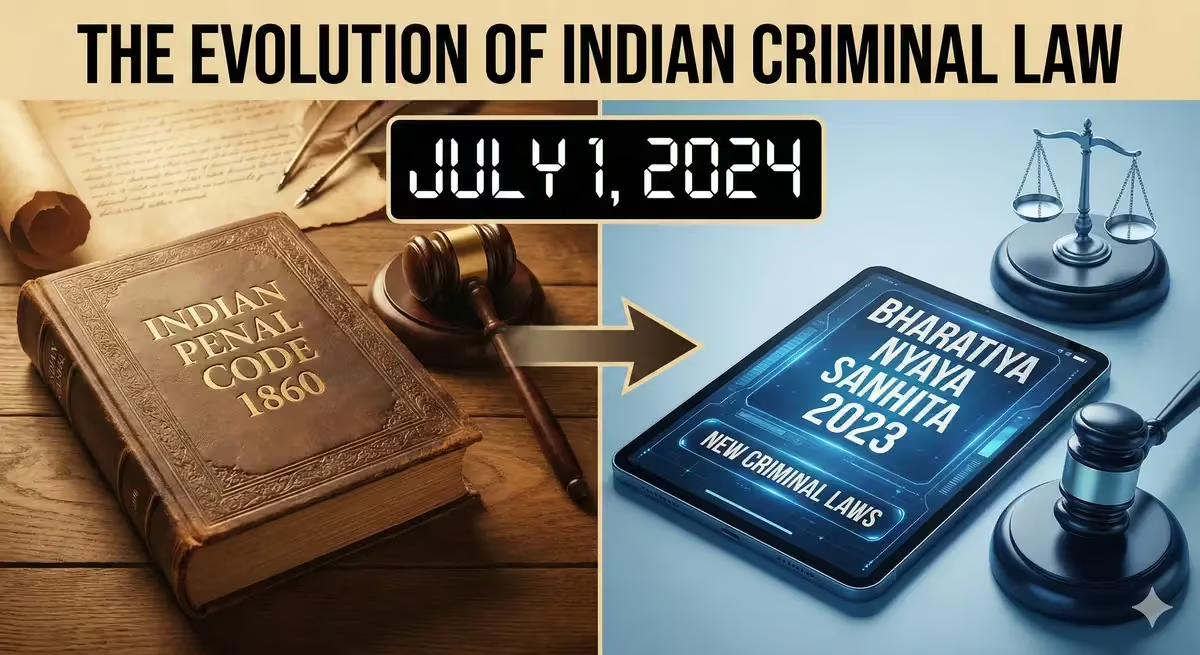
Imagine living in a house built in 1860. The foundation is solid, but the wiring is outdated, the layout doesn't fit modern life, and the roof leaks when the political climate changes. That house was the Indian Penal Code (IPC). For 164 years, India's criminal justice system operated on a framework drafted by Lord Thomas Babington Macaulay during the British Raj, a time when the steam engine was high-tech and the primary goal of the law was to control colonial subjects rather than serve citizens.
But on July 1, 2024, that era officially ended.
You might be wondering what this shift actually means for you. Is it just a name change from English to Hindi, or is it a fundamental rewiring of justice? The introduction of the Bharatiya Nyaya Sanhita (BNS) to replace the IPC is not merely administrative; it is the largest overhaul of India's criminal justice system since independence. We are talking about the introduction of community service as punishment for the first time, a distinct definition of terrorism within general law, and specific penalties for mob lynching—crimes that the 19th-century drafters could never have anticipated in their modern forms.
However, change rarely comes without complexity. While the government positions this as a move to shed "colonial baggage," legal scholars and civil rights activists have raised flags about expanded police powers and the vague phrasing of new treason laws. Whether you are a law student, a business owner, or just a citizen trying to stay informed, understanding these changes is no longer optional. In this deep dive, we will strip away the legal jargon to explore exactly what has changed, what has stayed the same, and how the new "Justice Code" impacts your daily life.
The Legacy of 1860 and The Need For Change
To understand where we are going, we have to look at where we came from. The Indian Penal Code was drafted in 1834 by the First Law Commission, chaired by Thomas Babington Macaulay, and it finally came into force in 1860. For over a century and a half, this document defined crime and punishment in India. It was a masterpiece of legal drafting for its time, but it was inherently designed to serve the interests of the British Crown, not the Indian citizen.
The Colonial Framework of Lord Macaulay The primary objective of the IPC was the preservation of order favorable to the colonial administration. According to historical analysis by the PRS Legislative Research, offenses against the state and public tranquility were prioritized over crimes against individuals. The code remained largely static even as India transformed into a democratic republic. While amendments were made over the decades, the core philosophy remained rooted in Victorian morality and colonial control.
The Stated Objective of Decolonization When Home Minister Amit Shah introduced the new bills in the Lok Sabha in 2023, the central argument was "decolonization." The government argued that the IPC was focused on "dand" (punishment), whereas the new Bharatiya Nyaya Sanhita focuses on "nyaya" (justice). According to the Statement of Objects and Reasons attached to the BNS bill, the goal was to remove archaic references to the British monarchy, modernize the language, and center the citizen in the justice process.
The Burden of Pendency and Delay Beyond ideology, there was a practical crisis. As of 2023, the National Judicial Data Grid reported over 40 million cases pending across Indian courts. The rigid procedures and outdated evidence standards of the colonial era were seen as major contributors to this backlog. The government posits that the new code, by streamlining definitions and embracing technology, will expedite justice delivery.
Structural Overhaul: IPC vs BNS
The transition from IPC to BNS is not just a copy-paste job; it involves a significant restructuring of how the law is organized.
Reduction in Total Sections The sheer volume of the code has been condensed. The Indian Penal Code contained 511 sections. In contrast, the Bharatiya Nyaya Sanhita contains 358 sections. According to the comparative analysis published by PRS Legislative Research in 2024, this reduction was achieved by repealing obsolete sections, merging similar provisions, and simplifying definitions. For instance, the definitions of various terms, which were scattered across Sections 6 to 52A in the IPC, have been consolidated into a single Section 2 in the BNS.
Consolidation of Definitions In the IPC, you might find the definition of a crime in one chapter and the explanation of specific terms used in that definition in a completely different chapter. The BNS attempts to fix this. It groups offenses more logically. For example, all offenses against women and children, which were previously scattered, are now brought together in a specific chapter (Chapter V).
The Shift from "Dand" (Punishment) to "Nyaya" (Justice) The nomenclature change is symbolic but significant. "Sanhita" implies a compilation or code, while "Nyaya" translates to justice. This framing is intended to signal a shift from a punitive approach to a restorative one. This is most visible in the introduction of community service as a punishment for minor offenses, a concept that was entirely absent in the 1860 framework.
Defining New Crimes for a Modern India
The world has changed since 1860, and the nature of crime has evolved. The BNS introduces specific provisions for offenses that previously had to be shoehorned into ill-fitting IPC sections.
Terrorism Defined for the First Time Under the IPC, there was no specific definition of "terrorism." Terror offenses were largely handled under special laws like UAPA (Unlawful Activities Prevention Act). The BNS changes this. Section 113 of the BNS provides a comprehensive definition of terrorism. It defines a terrorist act as one committed with the intent to threaten the unity, integrity, and security of India, or to strike terror in the people. This inclusion brings terrorism under the ambit of general criminal law, though the overlap with UAPA remains a point of legal discussion.
Mob Lynching and Hate Crimes In recent years, mob violence has been a critical issue. The IPC did not have a specific section for mob lynching; these cases were usually tried as murder (Section 302) or rioting. The BNS addresses this directly. Section 103(2) of the BNS specifically creates a distinct category for murder committed by a group of five or more persons acting in concert on grounds of race, caste, community, sex, place of birth, language, personal belief, or any other similar ground. The punishment for this offense extends to death or life imprisonment, signaling a zero-tolerance approach to vigilante justice.
Organized Crime and Petty Organized Crime For the first time, "organized crime" is defined in the general penal code. Section 111 of the BNS targets criminal syndicates involved in kidnapping, robbery, land grabbing, and contract killing. Furthermore, the BNS introduces a unique category called "petty organized crime" (Section 112), which covers acts like theft, snatching, and unauthorized selling of tickets by groups. This is designed to tackle street-level gang activity that plagues urban centers.
The Sedition Controversy: Repealed or Rebranded?
Perhaps the most politically charged aspect of the new law is the fate of "Sedition," famously enshrined in Section 124A of the IPC.
The End of Section 124A Section 124A was the tool used by the British to imprison freedom fighters like Mahatma Gandhi and Bal Gangadhar Tilak. It criminalized speech that excited "disaffection" against the government. The government announced the repeal of Section 124A as a major step in decolonization. Technically, the word "sedition" (Rajdroh) does not appear in the BNS.
Decoding Section 152: Acts Endangering Sovereignty However, legal experts argue that the spirit of the law persists in a new form. Section 152 of the BNS penalizes acts endangering the sovereignty, unity, and integrity of India. It criminalizes acts that excite "secession," "armed rebellion," or "subversive activities." According to an analysis by the Internet Freedom Foundation in 2024, while the word sedition is gone, the phrasing of Section 152 remains broad. The punishment can extend to life imprisonment.
Concerns Regarding Vagueness The key criticism here lies in the definition of "subversive activities," which is not clearly defined in the code. The Supreme Court of India had suspended the operation of the old Sedition law in May 2022 due to its misuse. Legal commentators in The Indian Express have noted that without precise safeguards, Section 152 could potentially be used to stifle political dissent much like its predecessor, Section 124A.
Crimes Against Women and Children
The BNS has restructured how crimes against women are categorized, giving them a more prominent position in the code.
Deceitful Means in Marriage (The "Love Jihad" Context) Section 69 of the BNS criminalizes sexual intercourse by employing "deceitful means." The law specifies that deceitful means include false promises of employment or promotion, or marrying after suppressing one's identity. While the text does not use the term "Love Jihad," political discourse surrounding the bill has often linked this provision to that concept. This section targets situations where consent is obtained through identity fraud.
Gang Rape and Minor Protection The BNS strengthens provisions regarding sexual violence. Gang rape (Section 70) now attracts a minimum sentence of 20 years, which can extend to life imprisonment. Crucially, for the rape of a minor under 18, the BNS prescribes life imprisonment or the death penalty. The categorization highlights the state's intent to prioritize the safety of women and children.
Gender Neutrality Issues A point of contention discussed by the Parliamentary Standing Committee was the issue of gender neutrality in rape laws. Under the IPC, rape laws were gender-specific (men as perpetrators, women as victims). The BNS largely retains this structure for rape, despite recommendations from some legal experts to make sexual assault laws gender-neutral to protect male and transgender victims as well.
Procedural Innovations and Technology
The BNS works in tandem with the Bharatiya Nagarik Suraksha Sanhita (which replaces the Code of Criminal Procedure or CrPC) to modernize how investigations are conducted.
Community Service as Punishment This is one of the most progressive additions. Section 4(f) of the BNS introduces community service as a valid form of punishment for petty offenses. This applies to crimes like minor theft, defamation, and misconduct by a drunken person. This moves away from the binary of "jail or fine" and aims to reduce the overcrowding in prisons while offering a restorative justice path for first-time offenders.
Mandatory Videography of Search and Seizure To curb police malpractice and the planting of evidence, the new laws mandate the videography of search and seizure operations. While this is technically part of the procedural code (BNSS), it is integral to how BNS offenses will be prosecuted. The emphasis is on electronic evidence, which is now given primary status, meaning digital records are treated as equivalent to paper documents.
The Zero FIR Concept The new framework institutionalizes the concept of "Zero FIR." This means a citizen can file a First Information Report (FIR) at any police station, regardless of jurisdiction. The police station must record it and then transfer it to the appropriate station. While Zero FIR existed through court precedents previously, the new laws give it statutory backing, aiming to eliminate the "jurisdiction excuse" often used by police to refuse complaints.
Criticisms and Constitutional Challenges
Despite the modernization, the BNS has faced significant pushback from the legal fraternity and civil society.
Expanded Police Custody Duration One of the most controversial changes relates to police custody. Under the old code, police custody (where the accused is with the police for interrogation) was generally limited to the first 15 days after arrest. Section 187 of the Bharatiya Nagarik Suraksha Sanhita (the procedural companion to BNS) allows police custody to be sought in tranches over a period of 60 or 90 days. The Supreme Court Bar Association and criminal law experts cited in The Hindu have argued that this exposes the accused to a prolonged risk of torture and coercion, effectively nullifying bail provisions during that period.
The Handcuffing Controversy The new laws expand the power of police to use handcuffs. Previously, Supreme Court judgments had restricted the use of handcuffs to prevent the dehumanization of prisoners. The new code allows handcuffing for a wide range of offenses, including economic crimes and organized crime. Critics argue this is a regression in human rights standards.
Implementation Challenges The transition from IPC to BNS creates a massive logistical nightmare. As reported by the Bar and Bench in 2024, lawyers and judges now have to navigate a dual system where old cases continue under IPC and new crimes are registered under BNS. The challenge of retraining the entire police force of India and updating court software is immense.
Key Takeaways
As we close this chapter on the transition from the Indian Penal Code to the Bharatiya Nyaya Sanhita, the most critical realization is that the "rules of the game" have fundamentally shifted. We have moved from a code written by colonial masters to control a subject population to a code drafted by a sovereign state to govern its citizens. The shift from "punishment" to "justice" is not just branding; it is evident in the introduction of community service and the prioritization of crimes against women and children.
TL;DR
End of an Era: On July 1, 2024, the Bharatiya Nyaya Sanhita (BNS) officially replaced the 1860 Indian Penal Code (IPC), ending 164 years of colonial-era criminal law.
Less Clutter, More Focus: The BNS reduces the total number of sections from 511 to 358, consolidating definitions and repealing obsolete laws to streamline the justice system.
Community Service Debut: For the first time in Indian legal history, community service has been introduced as a formal punishment for petty offenses like defamation and minor theft.
Terrorism Defined: The BNS brings a specific definition of "terrorism" into the general penal code (Section 113), which was previously handled mainly by special laws like UAPA.
Mob Lynching Penalty: A new specific provision (Section 103) punishes mob lynching with life imprisonment or death, addressing hate crimes committed by groups of five or more.
Sedition Replaced: The controversial Section 124A (Sedition) is repealed, but Section 152 introduces "acts endangering sovereignty," which critics argue retains the potential for misuse against dissent.
Love Jihad Context: Section 69 criminalizes sexual intercourse obtained through "deceitful means," including false promises of marriage or suppressing one's identity.
Police Custody Concerns: Legal experts have raised alarms over provisions that allow police custody to be spread over 60-90 days, potentially increasing the risk of custodial torture.
Digital Evidence: The laws mandate videography of search and seizure operations and grant electronic evidence equal legal status to paper documents to curb tampering.
Transitional Chaos: A significant challenge remains in the "dual system" where pending cases follow the old IPC while new crimes abide by the BNS, creating logistical hurdles for courts.
Sources and Further Reading
PRS Legislative Research. The Bharatiya Nyaya Sanhita, 2023. PRS India, 2023. https://prsindia.org/billtrack/the-bharatiya-nyaya-sanhita-2023
Ministry of Home Affairs. The Bharatiya Nyaya Sanhita, 2023 (Act No. 45 of 2023). The Gazette of India, December 25, 2023. https://www.mha.gov.in/sites/default/files/2024-01/The%20Bharatiya%20Nyaya%20Sanhita%2C%202023.pdf
Rajagopal, Krishnadas. Major changes in the new criminal laws. The Hindu, June 30, 2024. https://www.thehindu.com/news/national/major-changes-in-the-new-criminal-laws/article68351352.ece
Lok Sabha Secretariat. Statement of Objects and Reasons, The Bharatiya Nyaya Sanhita Bill, 2023. Sansad Digital Library, 2023. https://sansad.in/ls/legislation/bills
Internet Freedom Foundation. The Bharatiya Nyaya Sanhita: A privacy and digital rights analysis. IFF, 2024. https://internetfreedom.in/brief-on-the-criminal-law-bills-2023/
Vidhi Centre for Legal Policy. Comments on the Bharatiya Nyaya Sanhita Bill, 2023. Vidhi Legal Policy, 2023. https://vidhilegalpolicy.in/research/comments-on-the-three-criminal-law-bills-2023/
Bar and Bench. New Criminal Laws: The challenge of implementation. Bar and Bench, July 1, 2024. https://www.barandbench.com/columns/new-criminal-laws-challenge-implementation
Tripathi, Ashish. Explained: Sedition vs Treason in the new BNS. The Indian Express, December 21, 2023. https://indianexpress.com/article/explained/explained-law/sedition-law-repealed-bharatiya-nyaya-sanhita-9076363/
National Judicial Data Grid. Case Pendency Statistics. NJDG, 2023. https://njdg.ecourts.gov.in/njdgnew/index.php